

Establishment
Courtesy : Energy star products
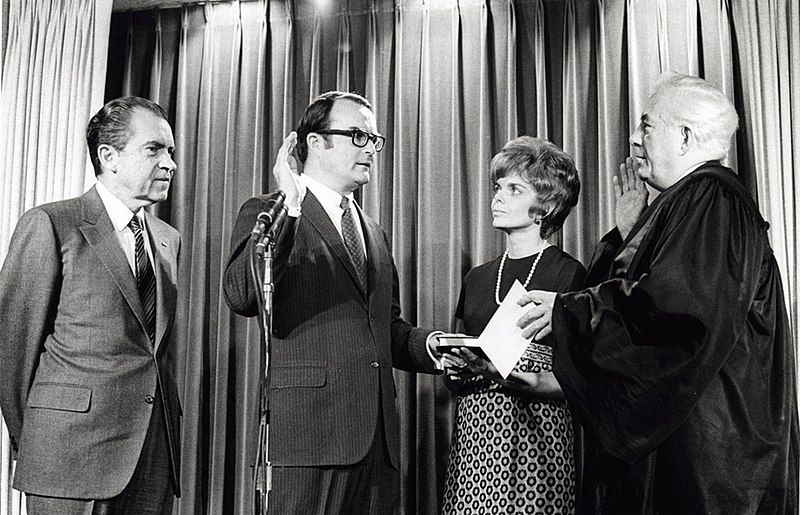
Ruckelshaus sworn in as first EPA Administrator.
On July 9, 1970, Nixon proposed an executive reorganization that consolidated many environmental responsibilities of the federal government under one agency, a new Environmental Protection Agency. This proposal included merging pollution control programs from a number of departments, such as the combination of pesticide programs from the United States Department of Agriculture and the United States Department of the Interior.: 5 After conducting hearings during that summer, the House and Senate approved the proposal. The EPA was created 90 days before it had to operate, 11 and officially opened its doors on December 2, 1970. The agency’s first administrator, William Ruckelshaus, took the oath of office on December 4, 1970. # ISO certification in India
EPA’s primary predecessor was the former Environmental Health Divisions of the U.S. Public Health Service (PHS), and its creation caused one of a series of reorganizations of PHS that occurred during 1966–1973. From PHS, EPA absorbed the entire National Air Pollution Control Administration, as well as the Environmental Control Administration’s Bureau of Solid Waste Management, Bureau of Water Hygiene, and part of its Bureau of Radiological Health. It also absorbed the Federal Water Quality Administration, which had previously been transferred from PHS to the Department of the Interior in 1966. A few functions from other agencies were also incorporated into EPA: the formerly independent Federal Radiation Council was merged into it; pesticides programs were transferred from the Department of the Interior, Food and Drug Administration, and Agricultural Research Service; and some functions were transferred from the Council on Environmental Quality and Atomic Energy Commission. # ISO certification in India
Upon its creation, EPA inherited 84 sites spread across 26 states, of which 42 sites were laboratories. The EPA consolidated these laboratories into 22 sites.
1970s
In its first year, the EPA had a budget of $1.4 billion and 5,800 employees. 5 At its start, the EPA was primarily a technical assistance agency that set goals and standards. Soon, new acts and amendments passed by Congress gave the agency its regulatory authority.: 9 A major expansion of the Clean Air Act was approved in December 1970. # ISO certification in India
EPA staff recall that in the early days there was “an enormous sense of purpose and excitement” and the expectation that “there was this agency which was going to do something about a problem that clearly was on the minds of a lot of people in this country,” leading to tens of thousands of resumes from those eager to participate in the mighty effort to clean up America’s environment.
When EPA first began operation, members of the private sector felt strongly that the environmental protection movement was a passing fad. Ruckelshaus stated that he felt pressure to show a public which was deeply skeptical about government’s effectiveness, that EPA could respond effectively to widespread concerns about pollution. # ISO certification in India
The burning Cuyahoga River in 1969 had led to a national outcry. In December 1970 a federal grand jury investigation led by U.S. Attorney Robert W. Jones began, of water pollution allegedly being caused by about 12 companies in northeastern Ohio. It was the first grand jury investigation of water pollution in the area. The attorney general of the United States, John N. Mitchell, held a press conference on December 18, 1970, referencing new pollution control litigation, with particular reference to work with the new Environmental Protection Agency, and announcing the filing of a lawsuit that morning against the Jones and Laughlin Steel Corporation for discharging substantial quantities of cyanide into the Cuyahoga River near Cleveland. Jones filed the misdemeanor charges in District Court, alleging violations of the Rivers and Harbors Act of 1899. # ISO certification in India
Partly based on such litigation experience, Congress enacted the Federal Water Pollution Control Act Amendments of 1972, better known as the Clean Water Act (CWA).The CWA established a national framework for addressing water quality, including mandatory pollution control standards, to be implemented by the agency in partnership with the states. Congress also amended the Federal Insecticide, Fungicide, and Rodenticide Act (FIFRA) in 1972, requiring EPA to measure every pesticide’s risks against its potential benefits.
In 1973 President Nixon appointed Ruckelshaus to the position of Deputy Attorney General. Russell E. Train was appointed to be the next EPA Administrator.
Congress passed the Safe Drinking Water Act in 1974, requiring EPA to develop mandatory federal standards for all public water systems, which serve 90% of the US population. The law required EPA to enforce the standards with the cooperation of state agencies.
In October 1976, Congress passed the Toxic Substances Control Act (TSCA) which, like FIFRA, related to the manufacture, labeling and usage of commercial products rather than pollution. This act gave the EPA the authority to gather information on chemicals and require producers to test them, gave it the ability to regulate chemical production and use (with specific mention of PCBs), and required the agency to create the National Inventory listing of chemicals. # ISO certification in India
Congress also enacted the Resource Conservation and Recovery Act (RCRA) in 1976, significantly amending the Solid Waste Disposal Act of 1965. It tasked the EPA with setting national goals for waste disposal, conserving energy and natural resources, reducing waste, and ensuring environmentally sound management of waste. Accordingly, the agency developed regulations for solid and hazardous waste that were to be implemented in collaboration with states.
President Jimmy Carter appointed Douglas M. Costle as EPA Administrator in 1977.
To manage the agency’s expanding legal mandates and workload, by the end of 1979 the budget grew to about $5.4 billion and the workforce size increased to about 13,000. # ISO certification in India
1980s
In 1980, following the discovery of many abandoned or mismanaged hazardous waste sites such as Love Canal, Congress passed the Comprehensive Environmental Response, Compensation, and Liability Act, nicknamed “Superfund.” The new law authorized EPA to cast a wider net for parties responsible for sites contaminated by previous hazardous waste disposal and established a funding mechanism for assessment and cleanup. # ISO certification in India
Anne Gorsuch was appointed EPA Administrator in 1981 by President Ronald Reagan. Gorsuch based her administration of EPA on the New Federalism approach of downsizing federal agencies by delegating their functions and services to the individual states. She believed that EPA was over-regulating business and that the agency was too large and not cost-effective. During her 22 months as agency head, she cut the budget of the EPA by 22%, reduced the number of cases filed against polluters, relaxed Clean Air Act regulations, and facilitated the spraying of restricted-use pesticides. She cut the total number of agency employees, and hired staff from the industries they were supposed to be regulating. Environmentalists contended that her policies were designed to placate polluters, and accused her of trying to dismantle the agency. # ISO certification in India
Following her mismanagement of the Superfund program, Assistant Administrator Rita Lavelle was fired by Reagan in February 1983. Lavelle was later convicted of perjury. Gorsuch had increasing confrontations with Congress over Superfund and other programs, including her refusal to submit subpoenaed documents. Gorsuch was cited for contempt of Congress and the White House directed EPA to submit the documents to Congress. Gorsuch (who had recently remarried, becoming Anne Gorsuch Burford) resigned in March 1983, followed by resignations of her Deputy Administrator and most of her Assistant Administrators. Reagan then appointed William Ruckelshaus as EPA Administrator for a second term. Lee M. Thomas succeeded Ruckelshaus as Administrator in 1985.
In April 1986, when the Chernobyl disaster occurred in Ukraine, the EPA was tasked with identifying any impacts on the United States and keeping the public informed. Administrator Lee Thomas assembled an interagency team, including personnel from the Nuclear Regulatory Commission, National Oceanic and Atmospheric Administration, and the Department of Energy to monitor the situation. They held press conferences for 10 days.: 9 That same year Congress passed the Emergency Planning and Community Right-to-Know Act, which authorized the EPA to gather data on toxic chemicals and share this information with the public. # ISO certification in India
EPA also researched the implications of stratospheric ozone depletion. Under Administrator Thomas, EPA joined with several international organizations to perform a risk assessment of stratospheric ozone, which helped provide motivation for the Montreal Protocol, which was agreed to in August 1987.: 14 # ISO certification in India
In 1988, during his first presidential campaign, George H. W. Bush was vocal about environmental issues. Following his election victory, he appointed William K. Reilly, an environmentalist, as EPA Administrator in 1989.Under Reilly’s leadership, the EPA implemented voluntary programs and initiated the development of a “cluster rule” for multimedia regulation of the pulp and paper industry. At the time, the environment was increasingly being recognized as a regional issue, which was reflected in 1990 amendment of the Clean Air Act and new approaches by the agency. # ISO certification in India