
Courtesy :Energy star products
Legal authority
The Environmental Protection Agency can only act pursuant to statutes—the laws passed by Congress. Appropriations statutes authorize how much money the agency can spend each year to carry out the approved statutes. The agency has the power to issue regulations. A regulation interprets a statute, and EPA applies its regulations to various environmental situations and enforces the requirements. The agency must include a rationale of why a regulation is needed. (See Administrative Procedure Act.) Regulations can be challenged in federal courts, either district court or appellate court, depending on the particular statutory provision. # ISO certification in India
Related legislation
EPA has principal implementation authority for the following federal environmental laws:
- Clean Air Act
- Clean Water Act
- Comprehensive Environmental Response, Compensation and Liability Act (“Superfund”)
- Emergency Planning and Community Right-to-Know Act
- Federal Insecticide, Fungicide, and Rodenticide Act
- Resource Conservation and Recovery Act
- Safe Drinking Water Act
- Toxic Substances Control Act
- Frank R. Lautenberg Chemical Safety for the 21st Century Act
There are additional laws where EPA has a contributing role or provides assistance to other agencies. Among these laws are:
- Endangered Species Act
- Energy Independence and Security Act
- Energy Policy Act
- Federal Food, Drug, and Cosmetic Act
- Food Quality Protection Act
- National Environmental Policy Act
- Oil Pollution Act
- Pollution Prevention Act
Programs
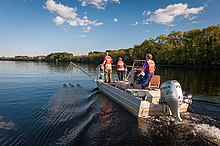
EPA scientists conducting a stream survey on the Merrimack River in Massachusetts
EPA established its major programs pursuant to the primary missions originally articulated in the laws passed by Congress. Additional programs have been developed to interpret the primary missions. Some of the newer programs have been specifically authorized by Congress.
Former Administrator William Ruckelshaus observed in 2016 that a danger for EPA was that air, water, waste and other programs would be unconnected, placed in “silos”, a problem that persists more than 50 years later, albeit less so than at the start.
Core programs
Air quality and radiation protection
The air quality and radiation protection programs implement the provisions of the Clean Air Act, the Atomic Energy Act, and related laws.
Ambient standards
- National Ambient Air Quality Standards (NAAQS)
- State Implementation Plans (SIPs)
Stationary air pollution source standards
- New Source Performance Standards
- National Emissions Standards for Hazardous Air Pollutants (NESHAPs)
- Permits for industrial and commercial sources
Mobile source standards
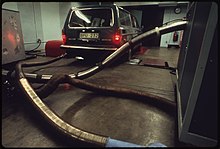
Testing automobile emissions at an EPA laboratory in Ann Arbor, Michigan
- On-road vehicles regulation
- Non-road vehicle regulation (including aircraft, locomotives, marine transport, stationary engines)
- Transportation fuel controls
- National Vehicle Fuel and Emissions Laboratory (NVFEL)
Radiation protection
The Radiation Protection Program comprises seven project groups.
- Radioactive Waste Management
- Emergency Preparedness and Response Programs Protective Action Guides And Planning Guidance for Radiological Incidents: EPA developed a manual as guideline for local and state governments to protect the public from a nuclear accident, the 2017 version being a 15-year update.
- EPA’s Role in Emergency Response – Special Teams
- Technologically Enhanced Naturally Occurring Radioactive Materials (TENORM) Program
- Radiation Standards for Air and Drinking Water Programs
- Federal Guidance for Radiation Protection
Water quality
Science and regulatory standards
- The National Pollutant Discharge Elimination System (NPDES) permit program addresses water pollution by regulating point sources which discharge to US waters. Created in 1972 by the Clean Water Act, the NPDES permit program authorizes state governments to perform its many permitting, administrative, and enforcement aspects. As of 2021, EPA has approved 47 states to administer all or portions of the permit program. EPA regional offices manage the program in the remaining areas of the country. The Water Quality Act of 1987 extended NPDES permit coverage to industrial stormwater dischargers and municipal separate storm sewer systems. In 2016, there were 6,700 major point source NPDES permits in place and 109,000 municipal and industrial point sources with general or individual permits.# ISO certification in India
See also: United States regulation of point source water pollution
- Effluent guidelines (technology based standards) for industrial point sources and Water quality standards (risk-based standards) for water bodies, under Title III of the CWA
- Nonpoint source pollution programs
- The CWA Section 404 Program regulates the discharge of dredged or fill material into waters of the United States. Permits are issued by the U.S. Army Corps of Engineers and reviewed by EPA, and may be denied if they would cause unacceptable degradation or if an alternative does not exist that does not also have adverse impacts on waters. Permit holders are typically required to restore or create wetlands or other waters to offset losses that can not be avoided.
- EPA ensures safe drinking water for the public, by setting standards for more than 148,000 public water systems nationwide. EPA oversees states, local governments and water suppliers to enforce the standards under the Safe Drinking Water Act. The program includes regulation of injection wells in order to protect underground sources of drinking water. # ISO certification in India