

Courtesy : Energy star products
Middle East
The Middle Eastern countries become part of the joint Islamic environmental action, which was initiated in 2002 in Jeddah. Under the Islamic Educational, Scientific and Cultural Organization, the member states join the Islamic Environment Ministers Conference in every two years, focusing on the importance of environment protection and sustainable development. The Arab countries are also awarded the title of best environment management in the Islamic world.
In August 2019, the Sultanate of Oman won the award for 2018–19 in Saudi Arabia, citing its project “Verifying the Age and Growth of Spotted Small Spots in the Northwest Coast of the Sea of Oman”.
Russia
In Russia, environmental protection is considered an integral part of national safety. The Federal Ministry of Natural Resources and Ecology is the authorized state body tasked with managing environmental protection. However, there are a lot of environmental issues in Russia.
Latin America
The United Nations Environment Programme (UNEP) has identified 17 megadiverse countries. The list includes six Latin American countries: Brazil, Colombia, Ecuador, Mexico, Peru and Venezuela. Mexico and Brazil stand out among the rest because they have the largest area, population and number of species. These countries represent a major concern for environmental protection because they have high rates of deforestation, ecosystems loss, pollution, and population growth.
Brazil
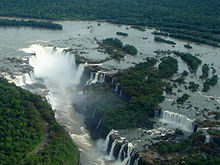
Panorama of the Iguazu falls in Brazil
Brazil has the largest amount of the world’s tropical forests, 4,105,401 km2 (48.1% of Brazil), concentrated in the Amazon region. Brazil is home to vast biological diversity, first among the megadiverse countries of the world, having between 15%-20% of the 1.5 million globally described species.
The organization in charge of environment protection is the Brazilian Ministry of the Environment (in Portuguese: Ministério do Meio Ambiente, MMA). It was first created in the year 1973 with the name Special Secretariat for the Environment (Secretaria Especial de Meio Ambiente), changing names several times, and adopting the final name in the year 1999. The Ministry is responsible for addressing the following issues:
- A national policy for the environment and for water resources;
- A policy for the preservation, conservation and sustainable use of ecosystems, biodiversity, and forests;
- Proposing strategies, mechanisms, economic and social instruments for improving environmental quality, and sustainable use of natural resources;
- Policies for integrating production and the environment;
- Environmental policies and programs for the Legal Amazon;
- Ecological and economic territorial zoning.
In 2011, protected areas of the Amazon covered 2,197,485 km2 (an area larger than Greenland), with conservation units, like national parks, accounting for just over half (50.6%) and indigenous territories representing the remaining 49.4%.[26]
Mexico
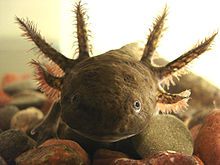
The axolotl is an endemic species from the central part of Mexico.
With over 200,000 different species, Mexico is home to 10–12% of the world’s biodiversity, ranking first in reptile biodiversity and second in mammals—one estimate indicates that over 50% of all animal and plant species live in Mexico.
The history of environmental policy in Mexico started in the 1940s with the enactment of the Law of Conservation of Soil and Water (in Spanish: Ley de Conservación de Suelo y Agua). Three decades later, at the beginning of the 1970s, the Law to Prevent and Control Environmental Pollution was created (Ley para Prevenir y Controlar la Contaminación Ambiental).
In the year 1972 was the first direct response from the federal government to address eminent health effects from environmental issues. It established the administrative organization of the Secretariat for the Improvement of the Environment (Subsecretaría para el Mejoramiento del Ambiente) in the Department of Health and Welfare.
The Secretariat of Environment and Natural Resources (Secretaría del Medio Ambiente y Recursos Naturales, SEMARNAT) is Mexico’s environment ministry. The Ministry is responsible for addressing the following issues:
- Promote the protection, restoration, and conservation of ecosystems, natural resources, goods, and environmental services and facilitate their use and sustainable development.
- Develop and implement a national policy on natural resources
- Promote environmental management within the national territory, in coordination with all levels of government and the private sector.
- Evaluate and provide determination to the environmental impact statements for development projects and prevention of ecological damage
- Implement national policies on climate change and protection of the ozone layer.
- Direct work and studies on national meteorological, climatological, hydrological, and geohydrological systems, and participate in international conventions on these subjects.
- Regulate and monitor the conservation of waterways
In November 2000 there were 127 protected areas; currently there are 174, covering an area of 25,384,818 hectares, increasing federally protected areas from 8.6% to 12.85% of its land area.
Oceania
Australia
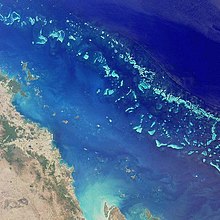
The Great Barrier Reef in Australia is the largest barrier reef in the world.
In 2008, there was 98,487,116 ha of terrestrial protected area, covering 12.8% of the land area of Australia. The 2002 figures of 10.1% of terrestrial area and 64,615,554 ha of protected marine area were found to poorly represent about half of Australia’s 85 bioregions.
Environmental protection in Australia could be seen as starting with the formation of the first national park, Royal National Park, in 1879. More progressive environmental protection had it start in the 1960s and 1970s with major international programs such as the United Nations Conference on the Human Environment in 1972, the Environment Committee of the OECD in 1970, and the United Nations Environment Programme of 1972. These events laid the foundations by increasing public awareness and support for regulation. State environmental legislation was irregular and deficient until the Australian Environment Council (AEC) and Council of Nature Conservation Ministers (CONCOM) were established in 1972 and 1974, creating a forum to assist in coordinating environmental and conservation policies between states and neighbouring countries. These councils have since been replaced by the Australian and New Zealand Environment and Conservation Council (ANZECC) in 1991 and finally the Environment Protection and Heritage Council (EPHC) in 2001.
At a national level, the Environment Protection and Biodiversity Conservation Act 1999 is the primary environmental protection legislation for the Commonwealth of Australia. It concerns matters of national and international environmental significance regarding flora, fauna, ecological communities and cultural heritage. It also has jurisdiction over any activity conducted by the Commonwealth, or affecting it, that has significant environmental impact. The act covers eight main areas:
- National Heritage Sites
- World Heritage Sites
- Ramsar wetlands
- Nationally endangered or threatened species and ecological communities
- Nuclear activities and actions
- Great Barrier Reef Marine Park
- Migratory species
- Commonwealth marine areas
There are several Commonwealth protected lands due to partnerships with traditional native owners, such as Kakadu National Park, extraordinary biodiversity such as Christmas Island National Park, or managed cooperatively due to cross-state location, such as the Australian Alps National Parks and Reserves.
There are several Commonwealth protected lands due to partnerships with traditional native owners, such as Kakadu National Park, extraordinary biodiversity such as Christmas Island National Park, or managed cooperatively due to cross-state location, such as the Australian Alps National Parks and Reserves.
At a local level, each city or regional council has responsibility over issues not covered by state or national legislation. This includes non-point source, or diffuse pollution, such as sediment pollution from construction sites.
Australia ranks second place on the UN 2010 Human Development Index and one of the lowest debt to GDP ratios of the developed economies. This could be seen as coming at the cost of the environment, with Australia being the world leader in coal exportation and species extinctions. Some have been motivated to proclaim it is Australia’s responsibility to set the example of environmental reform for the rest of the world to follow. # ISO certification in India