
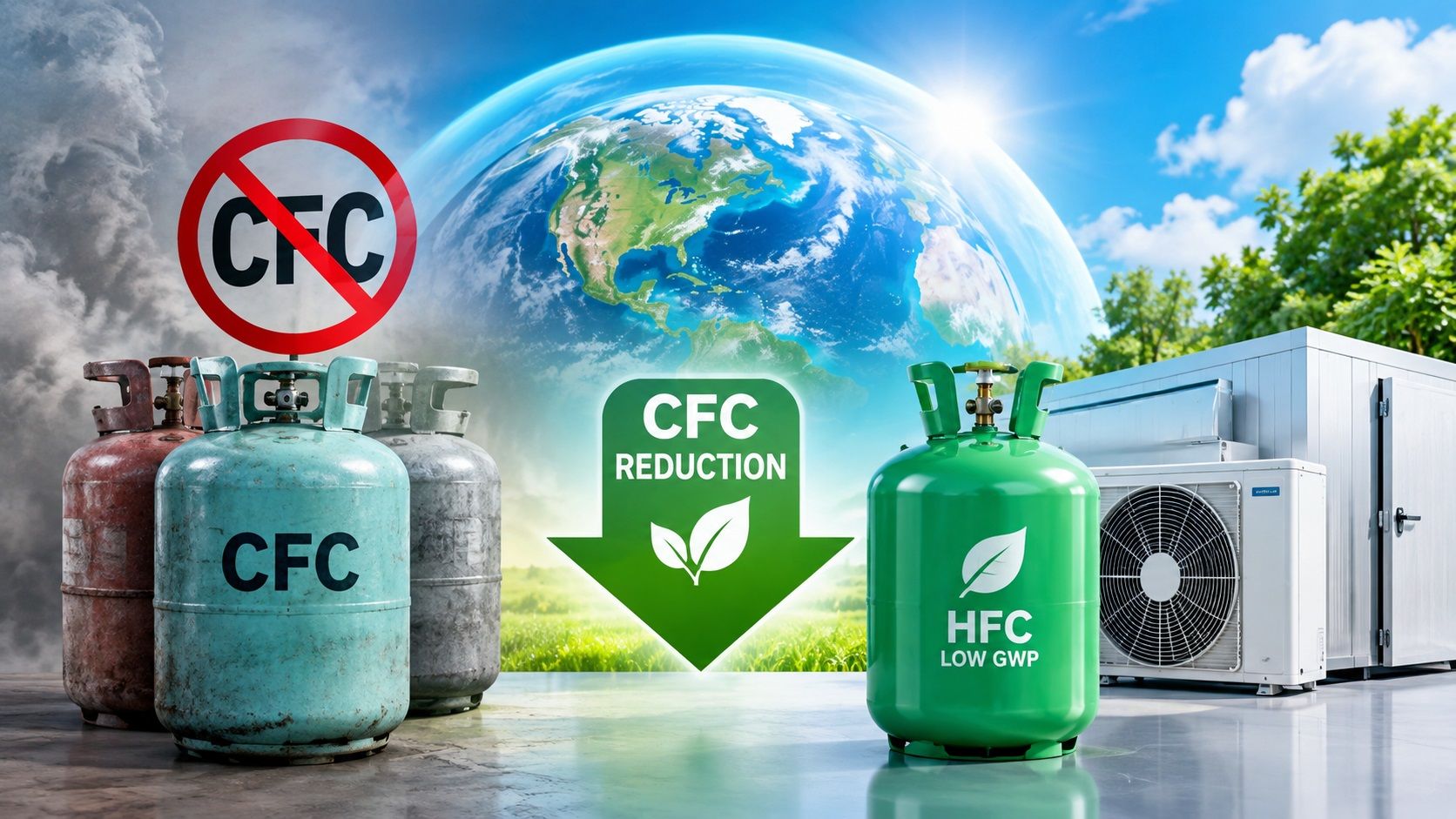
Environmental awareness graphic showing old CFC gas cylinders under a red prohibition symbol next to a green low-GWP HFC cylinder, a downward green arrow labeled "CFC REDUCTION," modern HVAC refrigeration equipment, and planet Earth set against smoke and clear sky backgrounds.

CFC reduction

courtesy : cfc reduction

Part of a series on
Pollution
Air pollution from a factory in Nepal
hideAirAcid rainAir quality indexAtmospheric dispersion modelingChlorofluorocarbonExhaust gasHazeIndoor airInternal combustion engineGlobal dimmingGlobal distillationOzone depletionParticulatesPersistent organic pollutantSmog AerosolSootVolatile organic compound
showBiological
showDigital
showElectromagnetic
showNatural
showNoise
showRadiation
showSoil
showSolid waste
showSpace
showThermal
showVisual
showWar
showWater
showMisc
 Environment portalicon Ecology portal
vte

Chlorofluorocarbons (CFCs) and hydrochlorofluorocarbons (HCFCs) are fully or partly halogenated hydrocarbons that contain carbon (C), hydrogen (H), chlorine (Cl), and fluorine (F), produced as volatile derivatives of methane, ethane, and propane. They are also commonly known by the DuPont brand name Freon.

The most common representative is dichlorodifluoromethane (R-12 or Freon-12). Many CFCs have been widely used as refrigerants, propellants (in aerosol applications), and solvents. Because CFCs contribute to ozone depletion in the upper atmosphere, the manufacture of such compounds has been phased out under the Montreal Protocol, and they are being replaced with other products such as hydrofluorocarbons (HFCs)[1] including R-410A and R-134a.[2][3]

Share

Translate »