
Courtesy :Energy star products
Specifications
Energy Star specifications differ with each item, and are set by the EPA.
Computers
Energy Star 4.0 specifications for computers became effective on July 20, 2007. The requirements are more stringent than the previous specification and existing equipment designs can no longer use the service mark unless re-qualified. They require the use of 80 Plus Bronze level or higher power supplies. Energy Star 5.0 became effective on July 1, 2009. Energy Star 6.1 became effective on September 10, 2014. Energy Star 7.1 became effective on November 16, 2018. The Version 8.0 specification for computers was finalized on October 15, 2019 and became effective on October 15, 2020. # ISO certification in India
Servers
The EPA released Version 1.0 of the Computer Server specifications on May 15, 2009. It covered standalone servers with one to four processor sockets. A second tier to the specification adding active state power and performance reporting for all qualified servers, as well as blade and multi-node server idle state requirements became effective December 16, 2013. The Version 2.0 Energy Star specification for Computer Servers came into effect on December 16, 2013. The Version 3.0 Energy Star specification for Enterprise Servers came into effect on June 17, 2019 . # ISO certification in India
Appliances
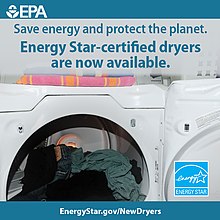
2015 advertisement promoting Energy Star-certified clothes dryers
As of early 2008, average refrigerators need 20% savings over the minimum standard. Dishwashers need at least 41% savings. Most appliances as well as heating and cooling systems have a yellow Energy Guide label showing the annual cost of operation compared to other models. This label is created through the Federal Trade Commission and often shows if an appliance is Energy Star rated. While an Energy Star label indicates that the appliance is more energy efficient than the minimum guidelines, purchasing an Energy Star labeled product does not always mean one is getting the most energy efficient option available. For example, dehumidifiers that are rated under 25 US pints (12 L) per day of water extraction receive an Energy Star rating if they have an energy factor of 1.2 (higher is better), while those rated 25 US pints (12 L) to 35 US pints (17 L) per day receive an Energy Star rating for an energy factor of 1.4 or higher. Thus a higher-capacity but non-Energy Star rated dehumidifier may be a more energy efficient alternative than an Energy Star rated but lower-capacity model. The Energy Star program’s savings calculator has also been criticized for unrealistic assumptions in its model that tend to magnify savings benefits to the average consumer. # ISO certification in India
Another factor yet to be considered by the EPA and DOE is the overall effect of energy-saving requirements on the durability and expected service life of a mass-market appliance built to a consumer-level cost standard. For example, a refrigerator may be made more efficient by the use of more insulative spacing and a smaller-capacity compressor using electronics to control operation and temperature. However, this may come at the cost of reduced interior storage (or increased exterior mass) or a reduced service life due to compressor or electronic failures. In particular, electronic controls used on new-generation appliances are subject to damage from shock, vibration, moisture, or power spikes on the electrical circuit to which they are attached. Critics have pointed out that even if a new appliance is energy efficient, any consumer appliance that does not provide customer satisfaction, or must be replaced twice as often as its predecessor contributes to landfill pollution and waste of natural resources used to construct its replacement. # ISO certification in India
Heating and cooling systems
Energy Star qualified heat pumps, boilers, air conditioning systems, and furnaces are available. In addition, cooling and heating bills can be significantly lowered with air sealing and duct sealing. Air sealing reduces the outdoor air that penetrates a building, and duct sealing prevents attic or basement air from entering ducts and lessening the heating/cooling system’s efficiency. Energy Star qualified room air conditioners are at least 10% more energy efficient than the minimum U.S. federal government standards. # ISO certification in India
Home electronics
Energy Star qualified televisions use 30% less energy than average. In November 2008, television specifications were improved to limit on-mode power use, in addition to standby power which is limited by the current specifications. Standby power consumption for televisions must be 3 watts or less. A wider range of Energy Star qualified televisions will be available.
Other qualified home electronics include cordless phones, battery chargers, VCRs and external power adapters, most of which use 90% less energy.
Imaging equipment
The Energy Star Program Requirements for Imaging Products are focused on product families such as electrophotographic (EP) printers, inkjet printers (e.g., thermal), copiers, facsimile machines and other imaging equipment including MFD’s (multifunctional devices). Typical Electrical Consumption (TEC) of a product family are measured and reported against an allowance set by the maximum throughput of the device. Operation modes (OM) are measured and reported for devices such as inkjet products against an allowance set by the functions present in the EUT (equipment under test). Devices that included “adders” such as Ethernet, on-board memory, wireless, etc. are mathematically “added” to increase the OM allowance. Recently on February 1, 2011, the EPA/DOE added the requirement that all products registered under the Energy Star service mark, must be tested by an AB (Accredited Body) or CB (Certification Body) Laboratory. # ISO certification in India