

Courtesy : Energy star products
Lighting
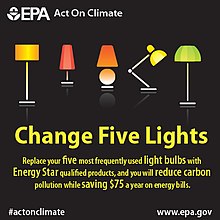
EPA graphic promoting light bulb replacement
The Energy Star is awarded to only certain bulbs that meet strict efficiency, quality, and lifetime criteria. Energy Star qualified fluorescent lighting uses 75% less energy and lasts up to ten times longer than normal incandescent lights.
Energy Star Qualified light-emitting diode (LED) Lighting:
- Reduces cooling costs — LEDs produce very little heat.
- Reduces energy costs — uses only 20–25% of the electricity that incandescent bulbs use, and last as much as 25 times as long. LEDs use 25%-30% of the amount of energy as halogen incandescent bulbs, and last 8–25 times as long.
To qualify for Energy Star certification, LED lighting products must pass a variety of tests to prove that the products will display the following characteristics:
- Brightness is equal to or greater than existing lighting technologies (incandescent or fluorescent) and light is well distributed over the area lighted by the fixture.
- Light output remains constant over time, only decreasing towards the end of the rated lifetime (at least 35,000 hours or 12 years based on use of 8 hours per day).
- Excellent color quality. The shade of white light appears clear and consistent over time.
- Efficiency is as good as or better than fluorescent lighting.
- Light comes on instantly when turned on.
- No flicker when dimmed.
- No off-state power draw. The fixture does not use power when it is turned off, with the exception of external controls, whose power should not exceed 0.5 watts in the off state.# ISO certification in India
New Homes
New homes or apartments that earn the Energy Star label have been verified to meet energy efficiency requirements set by U.S. EPA. Energy Star certified homes are at least 10% more efficient than homes built to code and achieve a 20% improvement on average, while providing homeowners with better quality, performance, and comfort. Nearly 1.9 million Energy Star certified homes and apartments have been certified to date. These high-performing homes can be found across the U.S. and include a complete thermal enclosure system, a high-efficiency heating, ventilation and cooling system, a comprehensive water management system, and energy-efficient lighting and appliances. Together, U.S. homeowners living in certified homes saved $360 million on their energy bills in 2016 alone. In 2020, ENERGY STAR separated single-family and multifamily construction types into their own programs: Single-Family New Construction (SFNC) and Multifamily New Construction (MFNC). # ISO certification in India
A new tier of ENERGY STAR certification, called the ENERGY STAR NexGen Certified Homes and Apartments, will be launched in 2023. This new certification uses a baseline of the ENERGY STAR Single-Family and Multifamily certification, with additional requirements such as heat pump water heaters and EV-ready charging capabilities.# ISO certification in India
Further information: Green building in the United States