

Courtesy :Energy star products
Past programs
- The former Construction Grants Program distributed federal grants for the construction of municipal wastewater treatment works from 1972 to 1990. While such grants existed before the 1972, the 1972 CWA expanded these grants dramatically. They were distributed through 1990, when the program and funding were replaced with the State Revolving Loan Fund Program.
- In 1991 under Administrator William Reilly, the EPA implemented its voluntary 33/50 program. This was designed to encourage, recognize, and celebrate companies that voluntarily found ways to prevent and reduce pollution in their operations. Specifically, it challenged industry to reduce Toxic Release Inventory emissions of 17 priority chemicals by 33% in one year and 50% in four years. These results were achieved before the commitment deadlines.
- Launched in 2006, the voluntary 2010/2015 PFOA Stewardship Program worked with eight major companies to voluntarily reduce their global emissions of certain types of perfluorinated chemicals by 95% by 2010 and eliminate these emissions by 2015.
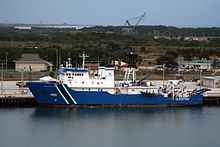
OSV Bold docked at Port Canaveral, Florida
- In March 2004, the U.S. Navy transferred USNS Bold (T-AGOS-12), a Stalwart class ocean surveillance ship, to the EPA. The ship had been used in anti-submarine operations during the Cold War, was equipped with sidescan sonar, underwater video, water and sediment sampling instruments used in study of ocean and coastline. One of the major missions of the Bold was to monitor for ecological impact sites where materials were dumped from dredging operations in U.S. ports. In 2013, the General Services Administration sold the Bold to Seattle Central Community College (SCCC), which demonstrated in a competition that they would put it to the highest and best purpose, at a nominal cost of $5,000. # ISO certification in India
Controversies
Scope and fulfillment of agency’s authority
Congress enacted laws such as the Clean Air Act, the Resource Conservation and Recovery Act and CERCLA with the intent of preventing and reconciling environmental damages. Beginning in 2018 under Administrator Andrew Wheeler, EPA revised some pollution standards that resulted in less overall regulation.
Furthermore, the CAA’s discretionary application has caused a varied application of the law among states. In 1970, Louisiana deployed its Comprehensive Toxic Air Pollutant Emission Control Program to comply with federal law. This program does not require pollution monitoring that is equivalent to programs in other states.# ISO certification in India
Environmental justice
The EPA has been criticized for its lack of progress towards environmental justice. Administrator Christine Todd Whitman was criticized for her changes to President Bill Clinton’s Executive Order 12898 during 2001, removing the requirements for government agencies to take the poor and minority populations into special consideration when making changes to environmental legislation, and therefore defeating the spirit of the Executive Order. In a March 2004 report, the inspector general of the agency concluded that the EPA “has not developed a clear vision or a comprehensive strategic plan, and has not established values, goals, expectations, and performance measurements” for environmental justice in its daily operations. Another report in September 2006 found the agency still had failed to review the success of its programs, policies and activities towards environmental justice. Studies have also found that poor and minority populations were underserved by the EPA’s Superfund program, and that this situation was worsening.
In September 2022 EPA announced the creation of a new Office of Environmental Justice and External Civil Rights that reports directly to the EPA administrator. The new office has an expanded budget and staff with broader responsibilities than under the previous organizational arrangement.
Freedom of Information Act processing performance
In the latest Center for Effective Government analysis of 15 federal agencies which receive the most Freedom of Information Act (FOIA) requests, published in 2015 (using 2012 and 2013 data, the most recent years available), the EPA earned a D by scoring 67 out of a possible 100 points, i.e. did not earn a satisfactory overall grade.# ISO certification in India