
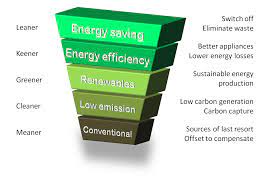
Courtesy : Energy star products
Organization

Headquarters of the EPA at the William Jefferson Clinton Federal Building
The EPA is led by the administrator, appointed following nomination by the president and approval from Congress. Michael S. Regan began serving as Administrator on March 11, 2021.
Offices
- Office of the Administrator (OA). As of October 2020 the office consisted of 12 divisions:
- Office of Administrative and Executive Services
- Office of Children’s Health Protection
- Children’s Health Protection Advisory Committee
- Office of Civil Rights
- Office of Congressional and Intergovernmental Relations
- Office of Continuous Improvement
- Office of the Executive Secretariat
- Office of Homeland Security
- Office of Policy
- Office of Public Affairs
- Office of Public Engagement and Environmental Education
- Office of Small and Disadvantaged Business Utilization
- Science Advisory Board
- Office of Air and Radiation (OAR)
- Office of Chemical Safety and Pollution Prevention (OCSPP)
- Office of the Chief Financial Officer (OCFO)
- Office of Environmental Justice and External Civil Rights
- Office of Enforcement and Compliance Assurance (OECA)
- Office of General Counsel (OGC)
- Office of Inspector General (OIG)
- Office of International and Tribal Affairs (OITA)
- Office of Mission Support (OMS)
- Office of Resources and Business Operations (ORBO)
- Environmental Appeals Board
- Office of Federal Sustainability
- Office of Administrative Law Judges
- Office of Acquisition Solutions (OAS)
- Office of Administration (OA)
- Office of Human Resources (OHR)
- Office of Grants and Debarment (OGD)
- Office of Customer Advocacy, Policy and Portfolio Management (OCAPPM)
- Office of Digital Services and Technical Architecture (ODSTA)
- Office of Information Management (OIM)
- Office of Information Security and Privacy (OISP)
- Office of Enterprise Information Programs (OEIP)
- Office of IT Operations (OITO)
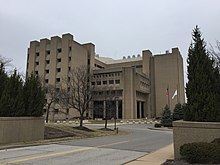
The Andrew W. Breidenbach Environmental Research Center in Cincinnati is EPA’s second-largest R&D center.
- Office of Research and Development (ORD) which as of November 2021 consisted of:
- Immediate Office of the Assistant Administrator
- Office of Science Advisor, Policy, and Engagement (OSAPE)
- Office of Science Information Management (OSIM)
- Office of Resource Management
- Center for Computational Toxicology and Exposure (CCTE)
- Center for Environmental Measurement and Modeling (CEMM)
- Center for Public Health and Environmental Assessment (CPHEA)
- Center for Environmental Solutions and Emergency Response (CESER)
- Office of Land and Emergency Management (OLEM) which as of March 2017 consisted of:
- Office of Superfund Remediation and Technology Innovation
- Office of Resource Conservation and Recovery
- Office of Underground Storage Tanks
- Office of Brownfields and Land Revitalization
- Office of Emergency Management
- Federal Facilities Restoration and Reuse Office
- Office of Water (OW) which as of March 2017 consisted of:
- Office of Ground Water and Drinking Water (OGWDW)
- Office of Science and Technology (OST)
- Office of Wastewater Management (OWM)
- Office of Wetlands, Oceans and Watersheds (OWOW)
Regions

The administrative regions of the United States Environmental Protection Agency
Creating 10 EPA regions was an initiative that came from President Richard Nixon. See Standard Federal Regions.
Each EPA regional office is responsible within its states for implementing the agency’s programs, except those programs that have been specifically delegated to states.
- Region 1: responsible within the states of Connecticut, Maine, Massachusetts, New Hampshire, Rhode Island, and Vermont (New England).
- Region 2: responsible within the states of New Jersey and New York. It is also responsible for the US territories of Puerto Rico, and the U.S. Virgin Islands.
- Region 3: responsible within the states of Delaware, Maryland, Pennsylvania, Virginia, West Virginia, and the District of Columbia.
- Region 4: responsible within the states of Alabama, Florida, Georgia, Kentucky, Mississippi, North Carolina, South Carolina, and Tennessee.
- Region 5: responsible within the states of Illinois, Indiana, Michigan, Minnesota, Ohio, and Wisconsin.
- Region 6: responsible within the states of Arkansas, Louisiana, New Mexico, Oklahoma, and Texas.
- Region 7: responsible within the states of Iowa, Kansas, Missouri, and Nebraska.
- Region 8: responsible within the states of Colorado, Montana, North Dakota, South Dakota, Utah, and Wyoming.
- Region 9: responsible within the states of Arizona, California, Hawaii, Nevada, the territories of Guam and American Samoa, and the Navajo Nation.
- Region 10: responsible within the states of Alaska, Idaho, Oregon, and Washington.
Each regional office also implements programs on Indian Tribal lands, except those programs delegated to tribal authorities. # ISO certification in India